
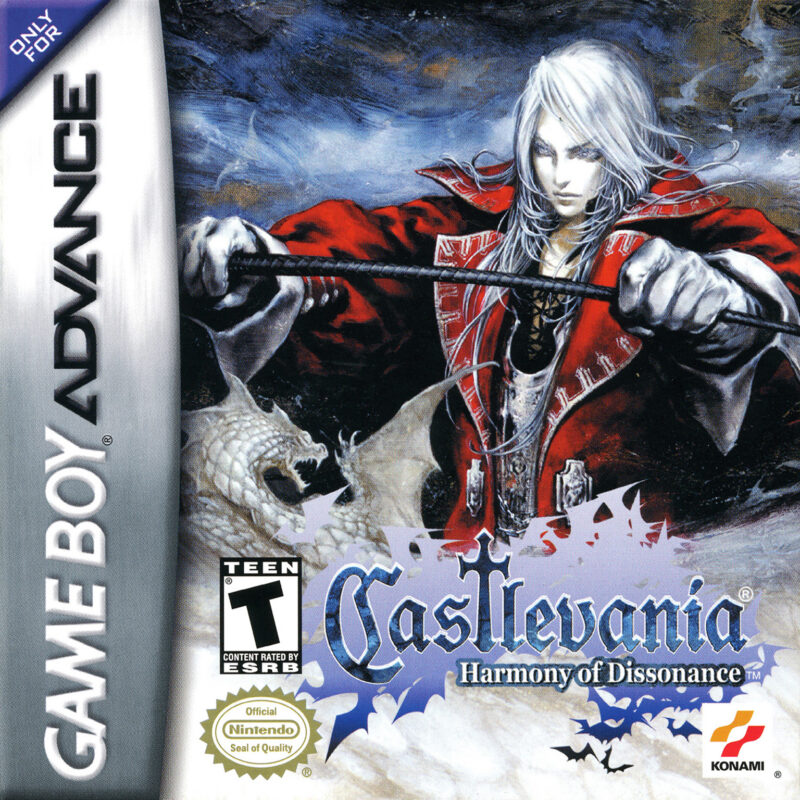
If I could pick one game to exemplify the idea of “deeply flawed but still fun”, it would be this one.
Harmony of Dissonance is truly a fascinating specimen. On the surface, it’s another game in the style of the PlayStation classic Symphony of the Night. It’s got the same broad Metroid-like structure, in which you explore a large castle in search of items that expand your moveset so you can explore even further, leveling up as you go. Even the big twist partway through the game is, at face value, quite similar to one in Symphony of the Night. And unlike its immediate predecessor, it’s even headed up by Symphony‘s Koji Igarashi.
All of that heritage shows, in a very, very good way. As in previous entries, unlocking new abilities is a great feeling. Even as the game gets harder, you feel more powerful. Exactly what a Metroidvania should be. And the hero this time around, Juste Belmont, has a slick new move right off the bat, allowing him to quickly dash left or right, to dodge attacks or generally move more quickly. Never has a Castlevania character felt more agile than Juste.
The story isn’t the most original in the series. It retreads several of the key elements of Circle of the Moon, often doing them better, but not really enough better to justify it outside of a couple of genuinely cool and interesting twists that stand out against all the repetition. I’m not convinced they’re enough, but they are cool.
Unfortunately, the deeper you dig into this game, the more shortcomings you’ll find, particularly in the gameplay.
There’s a new magic system that combines traditional Castlevania items such as the cross and the dagger with various elements, like a reimagined take on Circle of the Moon‘s DSS system. It can be fun to experiment with, to see all the different abilities you can perform with different combinations. It’s just a shame that virtually all of them are so powerful that there’s never any real need to experiment. Find something you like and it can functionally carry you through the game, turning down a lot of the already-low difficulty.
It’s a bit easy, it’s a bit cheesy, but that’s still fine, right? Plenty of great games are on the easy side. Heck, Symphony is even easier and that’s largely seen as the best game in the series. However, that’s not where it ends. You see, there’s a much bigger problem in this game:
The level design is among the most tedious in the franchise, if not the genre as a whole. It seems like nearly every vertical room in the game, and several of the horizontal rooms, borrowed a page from Knuckles Chaotix‘s playbook. You go all the way to the right. Then you jump up to the next level. Then you go all the way to the left. Rinse and repeat about 6 or 7 times. It gets old fast. And somehow, it still manages to be an absolute monster of a labyrinth. The game’s use of locked doors, portals, and the occasional obtuse goal makes finding where you’re supposed to go next an absolute chore, compounded by the tedium of actually getting there.
The difficulty curve is also messy. I described this game as on the easy side. This is, on average, true. This makes it all the more confounding when a basic enemy, especially a flying one, will be a sudden inexplicable difficulty spike. Then it’s weirder still when it gets easy again after you move to the next area. At times it gives the impression the designers didn’t even have a clear idea how easy or hard different elements are.
The experience tables would seem to support this hypothesis. Harmony has a mechanic where enemies have levels as well as the character, and once your level passes theirs you start getting less and less experience for each enemy you take down. Not a bad idea on paper, but in practice there are enemies that can be powerful, resilient, and challenging to dodge and only give 1 lonely experience point while other enemies are like tissue paper yet will provide far more experience simply by merit being later-game enemies, all while Juste is at the exact same level.
I understand what they were going for with this. A system like this is very clearly intended to dissuade grinding in favor of pushing forward. The experience debuffs even have the added effect of helping you know if you’re going the right way or not. The problem, though, is that the overall curve just winds up feeling wildly uneven.
Really, that’s a good way to sum up the whole game: wildly uneven. Because despite all these flaws making the game into a total slog at times and too easy at others, the magic is still there. It’s still a Koji Igarashi Castlevania game. And at least for me, I still had an overall good time. I’m not in any hurry to go back to it, and it’s definitely on the weaker side for what it is, but it’s not bad. I might not go as far as to call it good, but there are worse ways to spend your time.
The Good
- You can actually see on an original GBA
- Interesting magic system
- Dashing is fun!
The Bad
- Awful level design
- Zany difficulty curve
- Magic is overpowered