
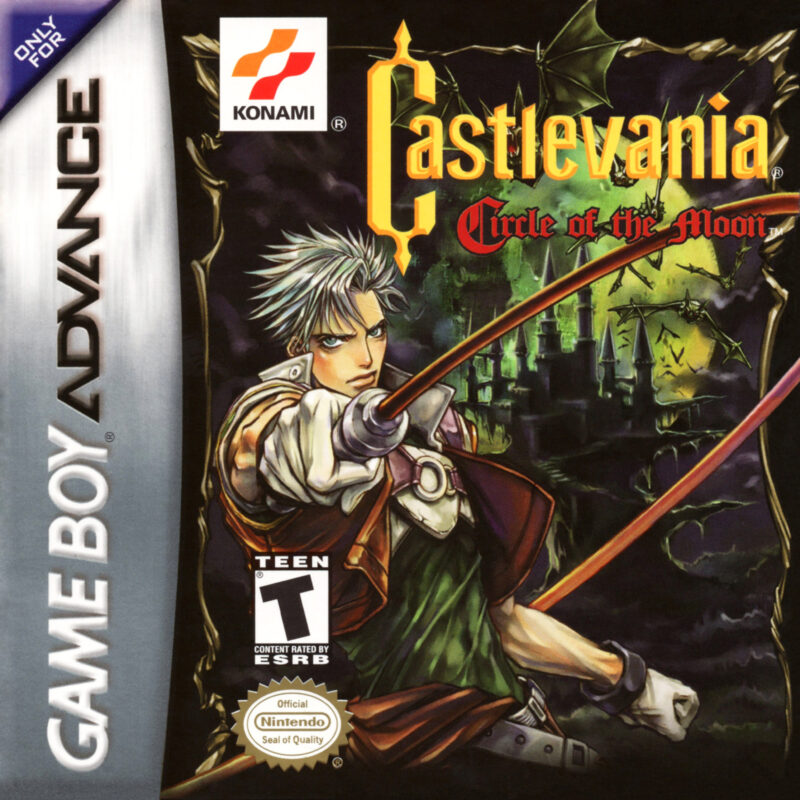
After restarting this game countless times over the past 25 years, I’ve finally beaten it. And I loved it.
Castlevania: Circle of the Moon is a game with a very strong reputation. It was the first real followup to 1997’s Symphony of the Night and broadly followed the same formula. But where its predecessor was largely a pretty easy game, Circle of the Moon is known for being punishing.
That reputation is merited, but as it turns out, more merited in the North American release than in the original Japanese version. Like Symphony, Circle has a leveling system. Defeat enemies, gain experience, level up, get stronger. Simple enough, RPGs have been doing it for ages. In Japan, this was pretty well balanced. When Konami brought this game to the west, however, they changed the experience required to level up. Every level now needs 20% more experience than it did in the Japanese release.
Where in the original release a player would naturally be at about the level you needed to be just by playing normally, now that player would have to make a choice: Either spend a bunch of time grinding to keep up, or get very good at the game and brute force it by pure skill. Neither was particularly ideal.
Circle of the Moon also introduces a new “DSS” card system. Certain enemies drop two kinds of cards: Action and Attribute cards. When you equip one of each type, you get an ability. Some are passive abilities that use magic over time, some are enhancements to your weapon that use magic with every swing of the whip, and some are entirely new abilities. The catch is, you can only have two cards equipped at once.
If this sounds like an interesting system with a ton of potential, that’s because it is. There are ten Action cards and ten Attribute cards in the game, for a total of 100 different abilities. Not all of them are created equal, but there’s plenty of room for experimentation, and it’s a lot of fun to try out new things every time you get a new card. There’s just one problem.
Card drops are super rare. A couple of the early ones are easy enough to get, with a 20% base drop rate, but for the most part you’re looking at closer to 1-2%. Even with a strategy guide telling you exactly which enemies drop which cards, and where to find them, and where the most optimal rooms to grind for them are, it’s gonna take a long time to find them all. If you’re playing casually, without a guide? Yeah, too bad. You’re never gonna see the vast majority of them.
I’m not really great at hard games. But this one always stuck with me, in the back of my mind, begging for me to come back to it. Every couple of years for over two decades, that itch would get strong enough that I would give it another try. But I never had the patience for the grinding, nor the skill to do it without. I would get maybe 20-30% of the way through the game and give up. It was only this year, 2026, that I would finally beat the game.
I learned a few things that made all the difference. First, I learned that the Japanese version was a lot more reasonable with its difficulty curve than the North American version I grew up playing. Second, I learned about a mod that brings that Japanese experience to the North American version while keeping the English-language translation. Third, I learned about another mod that places the cards throughout the castle to be found, rather than dropped by enemies. Lastly, I learned about yet another mod that enables auto-run rather than having to double-tap a direction after finding the relevant powerup. Okay, now we’re talking.
Truth be told, I don’t know how fair it is to review this game when, fundamentally, the game I beat is not the same as what’s actually available to buy. The difficulty mod, sure. That’s just how it always was in Japan anyway. The cards, though? They enabled me to finish the game, but I think it wouldn’t be fair to factor that into my final score.
One thing the mods didn’t change is the story. It’s pretty simple: You play as Nathan Graves, chosen by his master Morris Baldwin to wield the whip. Nathan’s best friend Hugh Baldwin, Morris’ son, is jealous that he wasn’t chosen, and that jealousy is ultimately used to corrupt Hugh and ultimately revive Dracula. Spoilers, I guess, but this story is pretty bare-bones. Ultimately you beat Hugh, he sees the error of his ways, you take down Dracula… All the stuff you might guess.
Fans of the series coming into this game might have one big question: “Who the hell are these people?” It’s a fair question. These characters have absolutely nothing to do with the Belmont family, or Alucard, or anyone else in the franchise, and in fact never appear again after this. Dracula is the same dude as always, and I suppose his follower Carmilla (here spelled “Camilla”, a more normal name but incorrect for this character) is a recurring character, but the vampire hunters? They exist only in Circle of the Moon. Notably, this game was made without the involvement of Symphony co-director and eventual series lead Koji Igarashi, and is officially not canon. Go figure.
I can’t really hold the skeleton of a story against this game. It does what it needs to, and dialogue is minimal enough that it never really gets in the way. But if you’re here for the plot, maybe look somewhere else.
All in all, I had an blast once I played the game with its original difficulty. The DSS system is novel and never really wears out its welcome, the level design is mostly superb, and the pacing is largely what it needs to be. This would be a solid 9/10, but for how utterly grindy even the Japanese version is with the DSS drop rates. Even so, it’s still easy to recommend. If you like hard games, play the North American version. If you aren’t a masochist, play the Japanese version. I do recommend modding it, but it’s a great game either way. It could’ve been stellar with a few tweaks, but great is still absolutely worth playing.
The Good
- Excellent level design
- Unique and varied DSS abilities
The Bad
- Hard to see on an original GBA
- Annoyingly grindy